Wednesday, April 24, 2013

Another Side of Jazz Samba: An Interview with Buddy Deppenschmidt


Buddy Deppenschmidt in 1992.

Stan Getz and Charlie Byrd’s 1962 album Jazz Samba is one of the most important popular music albums in history. Without it, bossa nova might never have boomed outside of Brazil and become such an indelible part of the world's music. And Jazz Samba might never have been recorded were it not for a young drummer's enthusiasm for bossa, which he first heard on a trip in early 1961 to Brazil. William "Buddy" Deppenschmidt, who played drums on the album, was on a U.S. State Department-sponsored tour of South America that year as part of the Charlie Byrd Trio, along with guitarist Byrd (1925-1999) and bassist Keter Betts (1928-2005). While in Salvador, he heard bossa nova for the first time, and was enraptured by the new style. He and Betts spent many hours on the trip trying to learn the new style, and when they returned to the U.S. they continued practicing. Eventually, they and Byrd started performing bossa nova songs at the Showboat Lounge in Washington, D.C.

According to Deppenschmidt, he was the first to suggest that the trio record a bossa nova album and he and Betts spent months trying to convince Byrd to do it. Byrd eventually talked to saxophonist Stan Getz about doing a joint album of bossa songs and played him a Gilberto record. Getz liked the music and the concept. He went to A&R executive Creed Taylor at Verve, who gave it a green light. According to many sources, they initially tried to record Jazz Samba in late '61 with Getz's musicians, and it didn't work. So, Buddy and Keter were brought back into the project.

In an August 29, 1963 Downbeat article by Leonard Feather, Byrd recalled, "We tried to make the album in New York, as you know, with a New York rhythm section, but they just couldn't make it. Buddy Deppenschmidt deserves an awful lot of credit for his part in the album; he spent so much time working on getting the exact rhythmic thing down." His wife Ginny added, "Buddy and Keter stayed up nights learning those rhythms." Byrd added, "All Stan had to do was come in and play. We had the rhythm section and the idea." Byrd picked the songs (by Antonio Carlos Jobim and others), provided the musicians, did the arrangements, and set up the recording session. Getz flew down from New York to Washington, D.C. for the day with Verve's Taylor, who produced the album. Jazz Samba was recorded in about two hours on February 13, 1962 at the All Souls Unitarian church. Drummer Bill Reichenbach and guitarist/bassist Joe (Gene) Byrd completed the lineup.


The original cover of Jazz Samba

Jazz Samba eventually made it to the no. 1 position on the Billboard pop albums chart, the only jazz instrumental album to have ever achieved that feat. One of its highlights was the sublime "Desafinado," a composition by Jobim and Newton Mendonça. With inspired soloing by Getz, the tune stayed on the pop singles chart for sixteen weeks, and won a "best solo jazz performance" Grammy for Getz. Jazz Samba stayed on the charts for seventy weeks and sold half a million copies within eighteen months. It was more jazz than bossa, but the new sound struck a nerve. Byrd and Getz were the first Americans to release an album of bossa nova songs, and it launched the bossa craze in the United States.

About a month after the release of Jazz Samba, Getz offered Deppenschmidt a gig, according to Buddy. Stan asked if he had a New York union card (he didn't) and said, "Well, if you can get one, you've got a job. We're getting a lot of requests for the bossa nova stuff and my drummer isn't getting it." Alas, the young Deppenschmidt was already working steadily in D.C. with Byrd and didn't want to pay the $500 for the card. "I was young and didn't realize how much my playing was worth and had a young family to support." It was a missed opportunity. Soon after, Byrd replaced Deppenschmidt in the trio with Reichenbach, although he used Buddy for another recording later in the year.

Deppenschmidt only received $150 for his playing on Jazz Samba. While Byrd took Verve's parent company MGM to court in 1964 for a fairer share of the album's royalties, Deppenschmidt waited much longer, until 2001, to sue Verve and its then parent, the Universal Music Group; according to the drummer, he reached a settlement with them around 2004. His and Betts' vital contributions to the conception and realization of the album were largely ignored until June 2004, when JazzTimes published David Adler's article "Stan Getz and Charlie Byrd: Give the Drummer Some." Buddy's account differs from that of the Byrd family; Elana Byrd (Charlie Byrd's sister-in-law) claims that the project was the idea of Charlie's wife Ginny. Whichever account is true, the album certainly wouldn’t have sounded the same without Deppenschmidt and Betts, in part because they were so enthusiastic about the new style and because of the hours they spent practicing it before recording with Byrd. The interview below tells Buddy's side of the story, which deserves to be heard.


Buddy Deppenschmidt (born February 16, 1936 in Philadelphia) played with Byrd from 1959-1962 and appeared on such albums as The Guitar Artistry of Charlie Byrd, Charlie Byrd at the Village Vanguard, Blues Sonata, Jazz Samba, Latin Impressions, and Once More! Charlie Byrd's Bossa Nova. He also performed with jazz figures such as Chet Baker, Mose Allison, Clark Terry, Coleman Hawkins, Herb Ellis, King Pleasure, Phil Woods, Lionel Hampton, and James Moody, and has long been active in jazz education. In recent years he has led his own group, Jazz Renaissance, and has been a faculty member at The Conservatory music school in Doylestown, Pennsylvania, where he teaches music theory and improvisation in jazz, Brazilian, Latin and other styles.

Chris McGowan: You filed a lawsuit against Verve and Universal Music Group in 2001. Was there a result?
Buddy Deppenschmidt: It went into mediation because they didn’t want it to go into court. I had to sign a gag order so I’m really not supposed to talk about it. But they reneged on part of their agreement. They didn’t fulfill their end of the bargain. I was even considering possibly re-opening the case. They didn’t treat me fairly at all. They claimed they couldn’t come up with any sales figures for Jazz Samba. They didn’t even know if it had sold a million copies. And I’m sure it went gold, platinum and diamond. It had to. You still play $18 or $19 for a copy of the CD when you go into one of the larger record shops. It’s there, everywhere, and still selling.

C: What year did the settlement take place?
B: I think maybe around 2004. I'm somewhat disappointed but can’t talk about it. I wish the Adler [JazzTimes] article had [already] come out; I would have probably been treated with more respect.

C: When Charlie Byrd sued MGM (Verve's owner then) back in 1964, did you not also sue them then because you didn’t have the money for the legal fees?
B: Yeah. I didn’t have enough money to hire a lawyer. I was in my twenties and very inexperienced. If only I had known then what I know now, I would probably have realized that any lawyer could have done it on a contingency basis. I know that of all the people who were involved in that project, the person who did the least was [Verve's] Creed Taylor, because all he had to do was show up.

C: Yet, even though you couldn’t afford a lawyer back then, why did you wait until 2001 to file suit? It had been such a long time and that album had sold so much over the years.
B: I’ll tell you why. Because I was busy playing and living in the present and not in the past. My girlfriend deserves a lot of credit because she’s the one that said this isn’t right, this isn’t fair. Let’s do something about it. She helped me and we put out a press release together and we sent it out to people.

C: So, your girlfriend talked you into pursuing it.
B: Yes, and I’m glad she did. Because I found it was more satisfying to know that I had at least done something about it. To just be complacent isn’t the way to go. And I had just given it up. I was so disappointed in the whole thing and the way it turned out, other than the way the music turned out well and that it was a successful venture, God knows it was successful for Verve records and for Stan Getz and for Charlie Byrd. But it wasn’t very successful for me. I was still happy to see my idea be materialized, and I was part of it and I got to do it and the music is there and it will be there forever. And I have to get my satisfaction from that. Because if I had dwelled on the fact that I didn’t get financial compensation, I would have been miserable over it, so I just had to dismiss that.

The 1961 tour of Latin America: Buddy Deppenschmidt, Charlie
Byrd and Keter Betts on the left and Ginny Byrd on the far right.


C: It all started with a three-month Latin American tour in 1961, sponsored by the State Department. How long were you in Brazil for?
B: Approximately two weeks. We went to eight cities—Bahia, Sao Paulo, Porto Alegre, Curitiba, Fortaleza, Recife, Belo Horizonte and Belém. We did not play in Belém. We didn’t go to Rio because the state department had sent large groups down there. Since we were just four people—Keter, Charlie, Ginny [Byrd's wife] and myself—they sent us to cover bases they hadn’t covered in the past. To send Count Basie’s band was airfare for twenty or thirty people. We were just four people. So they tried to send us to a lot of places that had never had any American jazz before. 

C: Was the purpose of the trip to spread American culture?
B: That’s what it was. It was called the Cultural Exchange Program, and we surely did culturally exchange. I learned a lot down there and I tried to teach everyone we had contact with, all the musicians. Whenever we’d get together I’d show them stuff and they’d show me stuff. Even after I got back to the United States I had drummers mailing me rhythms written out on paper. There were nights we stayed up all night. 

C: What did you perform in your concerts in Brazil?
B: We played a lot of Latin stuff in our repertoire. It was on our concert program. We had four programs and in each city the embassy would choose which program they wanted us to play. All of the programs had some Duke Ellington tunes and some Latin-type tunes. I got to play a lot of Latin rhythms, mostly based on rhumba.

C: When you were in Brazil, it must have been a pretty magical time, because in 1961 Brazil was at a peak in a lot of ways, and had much less crime and a much smaller population. You probably went at a great time. 
B: It was wonderful. I loved it, every minute of it. I’m glad I didn’t just go to embassy cocktail parties. I reserved most of my off time to hang out with local people and most of the time they were musicians, but not all of the time. Sometimes it would be like a local jazz club, or something like that (in Uruguay not in Brazil). I remember the people so well. I got letters for quite a while. 

C: You had some particularly important meetings in Salvador.
B: I got to meet Master Bimba [Mestre Bimba, the leader of the "capoeira regional" school of capoeira]. We were having lunch and when we were done lo and behold there was master Bimba with his troupe of guys and they were doing capoeira. And that’s when I got berimbau [lessons]. They got some shots of Charlie playing his guitar with master bimba after at the restaurant and some shorts of Bimba in my hotel room, giving me lessons on the berimbau. He made me a berimbau and taught me how to play it. I’m not a virtuouso but I can play it and I still do. I still have it and have used it on some recordings. I make a few now for my students and show them how to play it. I was really interested in the berimbau and particularly in the bossa stuff [Mestre Bimba Tocando Com Charlie Byrd on YouTube is a very short video showing Mestre Bimba with both Buddy and Charlie Byrd].

A late '60s photo of Buddy playing berimbau.

C: You also went to the house of a judge [Carlos Coqueijo Costa], and he played some bossa records for you. Was Charlie Byrd with you or were you off on your own?
B: He was with us then. They invited the whole group of us to his home for dinner, and after dinner we had wine and he played music for us and they passed the guitar and everyone played guitar. And his wife played the guitar; his son played piano and drums. That was the first time we ever heard Gilberto and Jobim. Keter and I went out the very next day and bought his [Gilberto]’s records. And we started rehearsing in our hotel rooms. Just he and I. Charlie was not included in that. 

C: At the judge’s house, were they teaching you the rhythms and also showing Charlie how to play bossa nova on the guitar?
B: Not really. You know, they weren’t giving me a lesson in it either. I was just fascinated with how his son played the brushes on a record jacket. He stuck an LP jacket between his knees and started playing brushes in it.

C: What were the two bossa albums you bought?
B: The first two João Gilberto Odeon recordings [Chega de Saudade and O Amor, O Sorriso e A Flor]. The judge brought the third one [João Gilberto] up to me in Washington D.C.

   
Mutinho (guitar), Malu (center) and Buddy.

C: You also learned a lot about Brazilian music in Porto Alegre?
B: About a week later in Porto Alegre this girl, Malu Pederneiras, came up to me after a concert and invited me to lunch at her house the next day. I didn’t know what to think of it. I thought maybe she was coming on to me. I didn’t know what to expect and it turned out to be a very wholesome regular get-together. It was a musical thing. She wanted me to come over and meet her boyfriend and he was going to show me how to play the [bossa nova] rhythm. Probably when she heard me playing Latin rhythms on drums, she thought, "We should show you how to play the new stuff. Come on over to the house tomorrow, bring your brushes and your sticks, and we’ll show you how to play it." She just invited me over to lunch and they started showing me how. Her boyfriend played guitar and was a drummer. His name was Mutinho. He’s playing in São Paulo now. She had her whole family there and her father didn’t go to work that day; he stayed home. And all of her relatives were there and friends. It was like a family reunion. We must have spent an hour or two where they were teaching me how to play the rhythm.

Mutinho, Buddy and Malu.

C: Were they teaching Charlie how to play the guitar? Was he there?
B: He wasn’t there. She just came to me and invited me over and didn’t say anything to anyone else.

C: So, you were already practicing bossa nova while you were in Brazil.
B: I loved the music. I fell in love with the music the first time I heard it. Keter too. And I said let’s rehearse a little bit while we’re here instead of waiting until we get back home. Let’s just get together and play in our rooms a little bit. And we started getting it together and I said [to Keter], "We’ve got to do an album of this stuff." I was really hot to do one. I didn’t even start talking to Charlie about doing an album until we got back to the States, and then when we got back I said, "We gotta do this. No one has heard this music in the States. It’ll be the first album if we do it." 

C: Well, Capitol had released the João Gilberto album Brazil's Brilliant João Gilberto [his second Brazilian LP, with a new title] in 1961 but it bombed. Nobody really listened to it.
B: It just goes to show. That’s the pure version. As far as I’m concerned that’s the real deal (laughs). I do what I do. I do my version of it. I was brought up and steeped in the bebop era and Stan Getz was my idol. I had all of his records, all of his stuff. I always did think he was a wonderful player. I thought to myself, this is the way we make it sound. But they really play it the pure way. I don’t know why [Gilberto's album] wasn’t a huge hit.

João Gilberto's debut album Chega de Saudade for Odeon in Brazil.

C: Well, I can hear that. For a huge massive success it was necessary for a slight translation. And João Gilberto’s voice was too different for Americans and he sang in Portuguese. You guys did an instrumental album. I just wonder if there would have been a bossa nova boom in the United States if Jazz Samba had never come out. Maybe nothing would have ever happened.
B: I thought the same thing. I think it opened up an opportunity for Brazilian musicians to come play music in this country and make a decent living doing what they do. And I thought it was great for them.

C: I think what you guys and Herbie Mann and others were playing was jazz bossa.
B: That’s what it is. You can’t call it bossa nova music because it’s not pure bossa nova. It is definitely a fusion of jazz and Brazilian music. And it’s a really nice combination. I can see why it was so popular because it was probably the mixture of the two that finally convinced [the public]. They weren’t ready to hear it the way João Gilberto did it, they weren’t ready for that, they couldn’t quite accept that. But what we did sort of hit a nerve and all of a sudden they said this is pretty good stuff. You can dance to it. It’s unobtrusive. You can have a conversation and it’s not in your face. And it’s interesting, it’s not boring, it’s not elevator music. It’s everything that you would want, actually.

C: Was the album your and Keter’s idea? Or was it your idea and he was trying to help you push it?
B: It was really my idea, but I wasn’t getting through. And at the time I was only about 25. Keter was about ten years older than me and had been with Charlie several years before I joined. So I said, "I’m not getting anywhere with Charlie, why don’t you help me, Keter? You’ve been longer with him and he’ll listen to you." And even that didn’t work. And then I went to Charlie’s wife [Ginny Byrd] and tried to talk her into doing it. She said she didn’t think it was the right thing for Charlie, because he was known for playing blues and classical. And I said, "Well, it’s guitar music. It’s perfect for him and we could do a great job. Why don’t you try to talk him into it?" Finally, I convinced her. Because we used to hang out together during intermission when Charlie would do his classical bit. We’d do a jazz set and then Keter and I would get off and Charlie would do twenty or thirty minutes of classical guitar [at the Showboat Lounge], and I would be hanging out with Ginny. I tried to sway her and I finally did. And she talked to Charlie. Keter had already done it, and I had been pushing it. And finally he decided maybe we should do this.

 
Betts (bass) and Deppenschmidt (drums) during the '61 tour.

C: Whose idea was it to play with Stan Getz?
B: The whole thing with Stan Getz was my idea. And I said, "Look, if you can’t get Stan Getz you can try to get Paul Desmond. He would be good for this music."

C: Once Byrd gave it the green light, the next hurdle was finding a receptive record label. Byrd's label, Riverside Records, wasn't interested.
B: Riverside didn’t want to have anything to do with it. No interest in it at all. Keter even mentioned to me that he played the records we bought for Orrin Keepnews [co-founder of Riverside] and he didn’t think much of it. I don’t understand why. It just goes to show you can be good but you don’t know everything. I’m sure he kicked himself in the butt after Jazz Samba came out and was such a big hit. And then everybody started going that way.

C: But producer Creed Taylor at Getz's label, Verve, was interested. According to many sources, at that point you almost were removed from the project, as Getz and Byrd recorded tracks with Getz's band in two or three sessions in October 1961 at Rudy Van Gelder's Studio in New York*.
B: Keter is the one who told me. Keter knew John [Neves], who was the bass player for Stan at the time, and he went to New York and he met John on the sidewalk and John said “Hi, how you doing, I just did a date with your boss today.” And Keter said, “What do you mean, you did a date with my boss?” And he said, “It’s the second one we’ve done and we couldn’t get one track that we could use. It’s that Brazilian stuff.” Keter is the one that came to me and told me this. Otherwise I wouldn’t have known about it. They tried to do it with Stan’s rhythm section, or at least his bass player and drummer. And Roy Haynes [Getz's drummer] is one of the finest jazz drummers you could wish to have in your group but at the time he wasn’t getting the feel of the bossa nova right and they didn’t get anything that worked.

[*Author's note: Charlie Byrd referred to The New York "phantom sessions" in the 1963 Down Beat interview mentioned earlier; it was also mentioned by Getz biographers Donald Maggin and Dave Gelly, John Litweiler (who wrote liner notes for a Jazz Samba reissue), and musicians Keter Betts and Roy Haynes (in the JazzTimes article by David Adler). The latter notes that the Verve master discography lists two recording sessions with Getz and Byrd on 10/25/1961 labeled "JAZZ SAMBA." Creed Taylor, however, denies that the "phantom sessions" ever took place.]

Creed Taylor

C: Why did Getz want to use only his own musicians?
B: I think the only reason they didn’t use Keter and me right off the bat was that Verve Records was insisting that Getz use his musicians and Charlie would be brought in as a guest artist. And the way it worked out they wanted to do it on Stan’s record label with Stan’s musicians. It would be Stan Getz and Charlie Byrd. Not Charlie Byrd and Stan Getz on Riverside.

C: But it didn't work out like that.
B: They tried to do it without us and it didn’t work.

C: Did Charlie ever talk to you about the failed recording dates?
B: Charlie never mentioned them.

C: They had to come back to you and Keter.
B: It finally came to pass. Charlie said he had decided to do the album. I said, "When?" And he said, "On Saturday." And Saturday was just three or four days away. It didn’t make me nervous because I was ready. So when they decided to do it with us it worked and we did it in two hours. 

C: You guys had been playing bossa nova at the Showboat Lounge already.
B: Yeah, it started then. It took almost six months before we started playing it in public and when we did it was received very well and Charlie liked that, and I think that [part of the reason] he finally gave in [was] because he saw that the public liked it and it was good music for us, guitar, bass and drums, perfect instrumentation. We were probably doing it in the club for three months, something like that.

C: In the days between when Charlie told you about the recording date and when you did it, were there any specific rehearsals of the material?
B: There were no rehearsals.

C: But you guys, by playing bossa tunes together at the Showboat Lounge, had essentially been rehearsing. So when you went to the recording session you were well rehearsed.
B: Absolutely. We were ready to rock and roll.

C: Did Charlie pick all the songs to be recorded on Jazz Samba? Did you have any input?
B: I had no input on the song selection. Charlie chose them and sketched out the simple charts.

C: You have disagreed with certain claims by Creed Taylor about the session.
B: In that [JazzTimes] article by David Adler, he [Taylor] denies there were any other attempts to make the record without us. [And] he says he brought a tape recorder and two microphones which is absolutely preposterous. Contrary to what Creed Taylor claims, there were nine mics including the ambient mic, which can be seen on a stand above us in the session photo. There were three microphones on the drum set alone, and Bill Reichenbach had a microphone because he was doing a thing on a snare drum with brush, and then Charlie’s brother had to have a microphone on his bass and guitar, and Keter had a microphone and Stan Getz had a microphone. Whoever wrote all that publicity from the record company, Hans Christian Anderson couldn’t have done a better job. I think “Jazz Samba” may have been the only thing that was Creed Taylor’s idea.

Stan Getz, Joe Byrd and Charlie Byrd at the Jazz Samba recording session.

C: The name of the album?
B: I think he came up with the title. Everyone thought he could walk on water because of Jazz Samba though he didn’t have a darn thing to do with it. The only thing he had to do—he was the A&R man at Verve and Stan Getz was under contract to Verve.

C: Speaking of all of you guys, it's amazing that Getz got so much of the credit. Charlie and you and Keter had been playing this for a few months. And Charlie set up the recording session and Getz just showed up and played for two hours.
B: It was more like Getz was sitting in with the Charlie Byrd Trio.

C: The actual recording session was about two hours long?
B: We started at noon and the recording was over by 2pm. They were listening to playback as I was packing my drums up. I was out of there by 3pm. Back over to the Showboat and getting my drum set back up for that night. Then I had to drive over to Arlington, Virginia where I lived, eat, take a shower, get dressed, and get back over to D.C. to play that night. So I wasn’t going to hang around and listen to the playback. "I’ve heard those tunes before, I’ve played those tunes before." 

C: Did it match what you wanted to do, your idea?
B: Yes, it did. Except that I hadn’t counted on having two bass players [Joe Byrd and Keter Betts] or a rhythm guitar player [also Joe Byrd], or another drummer [Reichenbach].

C: Was Joe Byrd someone who played with you at the Showboat Lounge much?
B: No.

C: He wasn’t part of the band.
B: He wasn’t part of the band, but there were a few times he substituted for Keter. I can only remember two or three times that Joe played bass while I was in the band.

C: You hadn’t expected him to be at the recording session?
B: I did not know that Bill Reichenbach was going to be on that date and I didn’t know that Joe was going to be on that date. Charlie told me at the last minute. I was thinking it was just going to be a quartet—Charlie, Keter, myself and Stan Getz. Our trio plus Getz. I didn’t know he was augmenting the band with two other people.

C: Why was Bill Reichenbach brought in to play on Jazz Samba?
B: Maybe Charlie had intentions of getting Bill Reichenbach in the band and letting me go. I don’t know.

Buddy, Keter and Charlie listening to playback
of The Guitar Artistry of Charlie Byrd in 1961.

C: When the album came out you didn’t get any credit for it having been your idea. Did you have any argument with Charlie about that?
B: No, I’ll tell you the truth. At the time I was just so excited that the album came out and I was happy with my job. I was getting to play the kind of music I wanted to play every night. It didn’t enter my mind that I wasn’t getting any credit. After he let me go, I thought, "Well, that’s gratitude for you." I talk him into doing this great album that’s very successful and then he fires me. I just don’t understand it. And then when he fired Keter two months later I thought he was losing his mind. If you’ve got Keter Betts, he was as good a bass player that has ever played [Betts went on to play for many years with Ella Fitzgerald]. I thought we had a great trio and it didn’t make any sense at all, musically. I’m now firmly convinced that the reason he let me and Keter go might have been the advice of Pete Lambros, who was his manager. He probably said, "Look, get rid of these guys and you’re going to take all the credit for this."

C: When did Getz ask you to come join his band in New York? Were you still in Byrd's trio? And had Jazz Samba come out? 
B: When Stan Getz asked me to join his band, it was because he was getting a lot of requests for bossa nova because of the release of the album. I was with Charlie when Stan offered me the job because I turned it down thinking that I had a solid position with Charlie, didn't want to leave him and relocate, and couldn't afford it. Therefore, I was still with Charlie when the album was released. [Later] he brought me back to do one album that was called Once More [Once More! Charlie Byrd's Bossa Nova]. At that time Bill Reichenbach was playing for him.

C: What happened between Getz and Byrd that they didn’t record together again?
B: I don’t know why. Maybe because Charlie sued for royalties and he rubbed him the wrong way.

C: Were they friends before Jazz Samba?
B: I don’t think they had really met each other.

C: Who are your favorite Brazilian musicians?
B: Who I really like a lot is Maysa. I really like the stuff she did. Jobim and Dom Um Romão.

C: What about percussionists Airto Moreira and Naná Vasconcelos?
B: I love Airto, and Mutinho.

C: When you recorded Jazz Samba, did it feel like something special when you were doing it?
B: Well, it felt like it was good. I had no idea that it was going to be as successful as it was. But I knew the music was going to be good. There was no way it was going to be bad.

^ ^ ^

Read more about Jazz Samba here:
Blame It On the Bossa Nova: Jazz Samba's 50th Birthday

Read about Getz/Gilberto and "The Girl from Ipanema" here:
The Girl from Ipanema: 50 Years Old in 2013

A four-CD box set of Stan Getz's bossa nova albums:
Stan Getz, The Girl from Ipanema: The Bossa Nova Years

Read more about Brazilian music:
The Brazilian Sound: Samba, Bossa Nova and the Popular Music of Brazil

^ ^ ^


Sunday, December 30, 2012

The Girl from Ipanema: 50 Years Old in 2013

The song "Garota de Ipanema" had its 50th anniversary in 2012, while the English-language version, "The Girl From Ipanema," celebrates that landmark in 2013.

Tall and tan and young and lovely, "The Girl From Ipanema" is also a survivor. The iconic tune has been recorded by a multitude of jazz greats and pop legends, as well as crooners of lesser talent, appeared on the soundtracks of remarkably diverse movies, ridden elevators from Shanghai to Chicago as a Muzak standard, and been subjected to innumerable lounge renditions. Through it all, it has endured as a global favorite and is the second most recorded song in the world according to Performing Songwriter magazine, trailing only "Yesterday" by the Beatles. The song's original version, "Garota de Ipanema," with music by Antonio Carlos ("Tom") Jobim and Portuguese lyrics by Vinícius de Moraes, was first performed in 1962 and celebrated its fiftieth anniversary in 2012. Meanwhile, Stan Getz and João Gilberto's debut recording of "The Girl From Ipanema," which added English lyrics, turns fifty in 2013.

Hêlo Pinto, the OG (Original Girl) from Ipanema

"Garota de Ipanema" made its debut in August, 1962 at a club in Copacabana called Au Bon Gourmet, during a show that ran for several weeks and featured the first and only joint performances of bossa nova's three most important figures—Jobim, the poet-lyricist-singer de Moraes and guitarist-singer João Gilberto (who invented the bossa nova beat on the guitar and is the genre's greatest interpreter). They were backed on stage by Otávio Bailly on bass, Milton Banana on drums, and the Os Cariocas vocal group. Bossa nova was four years old in Brazil and had run a little off track with its own success; the show's participants and its producer Aloysio de Oliveira hoped to remind audiences about the style's fundamental strengths with the all-star event. The concerts garnered rave reviews and nightly packed the room, which could just barely squeeze in three hundred patrons. "Garota de Ipanema" was received with cries of "how beautiful!" The Au Bon Gourmet sessions were also a launching pad for several other tunes that are now classics: Jobim and de Moraes debuted "Só Danço Samba"; Jobim launched "Samba do Avião"; and Vinícius introduced "Samba da Benção" and "O Astronauta," which he had written with Baden Powell.

Vinícius, Tom, João and Os Cariocas at Au Bon Gourmet

"Garota de Ipanema" made its Brazilian recording debut in January of 1963, with separate releases by vocalist Pery Ribeiro and the instrumental group Tamba Trio. Its monster global success was yet to come, however.

The inspiration for the song was a beautiful, tanned teenaged girl named Heloisa ("Helô") Eneida Menezes Paes Pinto who lived on Rua Montenegro in Ipanema and used to “sway so gently” past the Veloso bar on her street as she made her way to the beach or around town. Jobim and de Moraes were regulars at Veloso, where they gathered to chat and down copious quantities of beers and scotch. They didn't fail to notice the young woman's charms as she passed by, often whistling in appreciation and calling out to her, as did other male patrons, all to no avail.

Hêlo at the beach in Rio

They turned their appreciation of the young woman into a song, but didn't compose the tune on napkins at Veloso, contrary to many reports. Rather, Vinícius penned the lyrics in Petropolis, in the mountains north of Rio. Jobim composed the music on the piano in his Ipanema apartment on Rua Barão da Torre. The song had a working title of "Menina Que Passa" (Girl Who Passes By), was originally intended for a musical comedy called Dirigível (Blimp), and initially had a different opening verse.

The next month, bossa nova really took off overseas, thanks to jazz saxophonist Stan Getz and guitarist Charlie Byrd's Jazz Samba album. It had been released in April 1962 and the album and its instrumental hit single "Desafinado" (by Jobim and Newton Mendonça) entered the Billboard pop charts in September. Jazz Samba ultimately hit no. 1 and stayed on the charts for seventy weeks. Jazz and pop musicians released a flood of bossa-themed albums. Getz quickly followed up with Big Band Bossa Nova and Jazz Samba Encore, making the pop charts with both.

Jobim, Getz and Gilberto at the recording session

By March of 1963, the bossa nova craze was starting to lose steam in the U.S. but many good recordings with the style were still being made. Getz had long wanted to play with Gilberto and Jobim and invited them to New York to record an album. Getz/Gilberto had the small stellar lineup of Getz (saxophone), Gilberto (guitar and vocals), Jobim (piano), Milton Banana (drums), and Tommy Williams (bass). It was a dream lineup and a chance for Getz to go straight to the source of bossa nova and play with its two greatest musical figures: João and Tom. Yet it wasn't all smooth sailing. Getz still wasn't getting bossa nova quite right and Gilberto the perfectionist was impatient with him, saying things in Portuguese to Jobim like, "Tom, tell the gringo he's a moron," according to Brazilian journalist Ruy Castro. But Getz biographer Donald L. Maggin claims that Stan and João shared a great rapport, and that a major problem arose the first day when the naturally shy and reclusive Gilberto refused to leave his hotel room to go to the recording session. It reportedly took hours of pleading by Getz's wife Monica to get him to the studio. In any event, it all came together, especially after Getz downed a few shots of whiskey, and the memorable LP was cut on March 18 and 19, 1963.

Getz, Milton Banana, Jobim, Creed Taylor, João and Astrud

Two of the album's tunes, "Corcovado" and "The Girl From Ipanema," featured the light, gentle vocals of João’s wife, Astrud Gilberto, who had practiced singing with João and performed at informal bossa gatherings but was not yet a professional. Getz claimed it was his idea to include her on the album and that Tom and João opposed it; Ruy Castro wrote that it was Astrud's idea; Tom said that it was his and João's inspiration; and, Astrud herself was quoted as saying that it was all her husband's idea. In any event, it worked far better than anybody could have hoped for. Some Brazilian musicians still cringe at her somewhat amateurish performance on "The Girl From Ipanema," but it's hard now to imagine the song having become such a success without her cool, slightly awkward, innocent yet sexy vocals. Astrud sang about the girl from Ipanema and for many listeners was the girl in the song.

Norman Gimbel wrote the English lyrics for "The Girl From Ipanema," which were inspired by the original Portuguese words by Vinícius but were not a translation. He also cut out two syllables (and two repetitive notes) from the opening phrase, going from "Olha que coisa" (five syllables) to "Tall and tan" (three syllables), as noted by Jobim biographer Sérgio Cabral, who claimed Tom wasn't bothered by it. Gimbel himself noted, in an email sent to me, that "I simplified [the music] by taking out some notes from the original to give it 'edge.' "

Lyricist Norman Gimbel

Gene Lees, the English-language lyricist for several famous Jobim songs and a noted jazz essayist, wasn't happy with the adjustments. In one of his books he wrote, "The opening line contains five notes; Gimbel reduced this to three…which completely destroys the swing."

However, Gimbel felt the change was part of what made the song a huge worldwide success, along with the English lyrics, which "told a universal story in a fun international (American) way," said Gimbel. In both versions, the observer admires the beauty of the pretty girl walking by and is sad that she isn't his. In the Portuguese lyrics, he doesn't think about doing anything about it. But in the American version, the observer wishes he could talk to her.

                         But I watch her so sadly
                         How can I tell her I love her
                         Yes I would give my heart gladly
                         But each day, when she walks to the sea
                         She looks straight ahead not at me

Vinicius's lyrics are more of a poetic lament, a meditation on youthful beauty. Gimbel tells a tale of a one-sided, frustrated romance and his words are more about the girl herself.

Gimbel mentions the words "the girl from Ipanema" during the song, while the Brazilian lyrics mention that she has a "golden body from the Ipanema sun" but don't ever call her the "girl from Ipanema." Her appearance is less abstract and more tangible in the English version. Instead of "look, what a beautiful thing, so graceful" (Vinícius) we have "tall and tan and young and lovely" (Gimbel), which creates a more striking impression.

Gimbel managed to both evoke the celebratory/melancholy mood of the original song and successfully imprint a character in the public imagination. The original lyrics are more subtle and poetic, but the direct English words were probably essential to the song's enormous global success.

Tall and tan and young and lovely
The girl from Ipanema goes walking
When she walks she’s like a samba
That swings so cool and sways so gently

João and Astrud's vocals were both included in "The Girl From Ipanema" track on Getz/Gilberto. João sings the Portuguese lyrics, Astrud sings the English lyrics, Getz delivers a sublime sax solo, Jobim follows with a short piano solo, and then Astrud's voice and Getz's sax close it together. It is the greatest performance of the song, but when it came time to release the single, producer Creed Taylor cut out João's vocals entirely, leaving only the English lyrics and reducing the song's length to just over three minutes.


Astrud and Getz perform the abridged version of "The Girl From Ipanema"

Taylor kept the album on the shelf for a year, not wanting to compete with Jazz Samba, which was still riding high on the charts. As a result, the song—with the title "The Girl From Ipanema" but in an instrumental form—made its U.S. debut in 1963 on Jobim's album The Composer of "Desafinado" Plays, which had been recorded two months after Getz/Gilberto but released immediately.


Getz/Gilberto, released by Verve in 1964

Verve released Getz/Gilberto only in March 1964 and "The Girl From Ipanema" single in April of that year. Both hit the pop charts in June. “The Girl From Ipanema” bridged the language gap with the U.S. audience and the breezy song won the Grammy Award for Record of the Year in 1964 (awarded to Stan and Astrud) and went to number 5 on the Billboard singles chart. With one suave stroke, it altered Brazil's international image. One might have previously pictured Carmen Miranda, coffee and the Amazon when thinking of Brazil, or perhaps even Brasília and modernist architect Oscar Niemeyer. Now, "The Girl From Ipanema" was a new symbol of the country, with its casual sophistication, its paean to unattainable young beauty, and the implicit evocation of beachside Rio's easygoing charm in the early '60s. Astrud's participation in the song made her an instant star and provided her with an international singing career, although she didn't earn a penny from the hit single or the album.

Astrud Gilberto with Stan Getz

Most importantly, "The Girl From Ipanema" opened the minds of listeners across the world to the richness of Brazilian music. Its smooth syncopation and graceful lyricism made it into a standard. Unfortunately, in the 1960s and '70s it was so overplayed that in the United States “The Girl From Ipanema” began to epitomize pop corniness. In 1980, it was heard as elevator music in the comedy "The Blues Brothers." Happily, time has dissipated the excesses of commercialization and the song’s definitive version (the unabridged track from Getz/Gilberto) is again a delight to hear: cool, seductive, and wistful.

The album Getz/Gilberto garnered three other Grammys (Best Album, Best Instrumental Jazz Performance (Small Group), and Best Engineered Recording (Non-Classical) as well and went to number 2 on the pop charts. It failed to reach number 1 only because the Beatles were making pop music history that year. Getz/Gilberto spent an extraordinary ninety-six weeks on the charts, fifty of them in the Top 40. It has never gone out of print and deserves its success: the album is a great marriage of Getz's sensuous, lyrical saxophone with João and Tom's sublime bossa nova.

The Garota de Ipanema bar/restaurant (formerly Veloso)

Helô became nationally famous in 1965 once Jobim and Vinícius revealed her as the inspiration for the song. Jobim was smitten by the young woman and proposed marriage to her several times, all in vain. She married her boyfriend, an engineer, became Helô Pinheiro, and had four children. She became a friend to the famous songwriters, although remained an unattainable muse for them. Today the Veloso bar is named Garota de Ipanema, after the song. The street it faces, Rua Montenegro, is now called Rua Vinícius de Moraes.

^ ^ ^

Resources:

Getz/Gilberto (Original Recording Reissued)

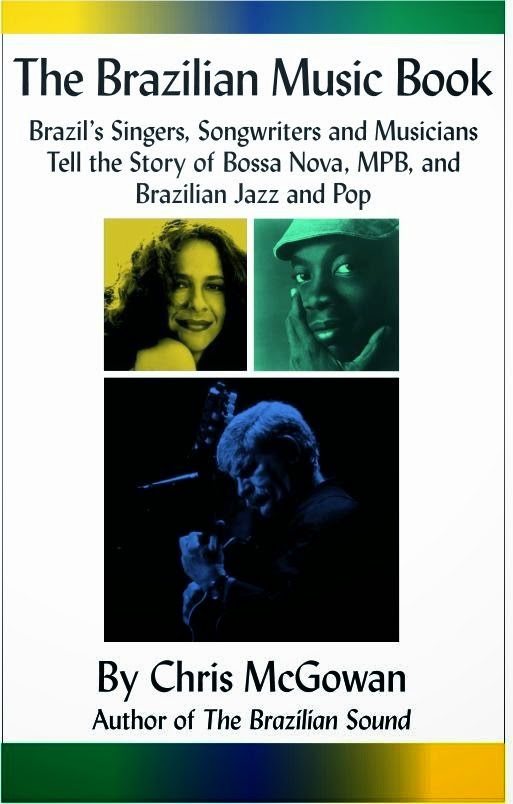
The Brazilian Music Book by Chris McGowan (Kindle edition)

The Brazilian Sound (3rd edition) by Chris McGowan and Ricardo Pessanha (paperback)

^ ^ ^

Monday, July 2, 2012

Carol Saboya: Belezas


Brazilian vocalist Carol Saboya, known for her clear, sweet, pitch-perfect voice, often brings a jazz interpretation to a bossa nova and MPB repertoire. Along those lines, she has just released Belezas, devoted to songs by Ivan Lins and Milton Nascimento, MPB icons who are two of Brazil's greatest composers. Nascimento's "Bola de Meia, Bola de Gude," "Tristesse," "Anima," and "Tarde," and Lins's "Velas Içadas," "Doce Presença," and "Abre Alas" are among the twelve selections, five of which include English-language lyrics. Hendrik Meurkens, a German harmonica player who has collaborated with many Brazilian musicians, is featured on "Doce Presença." Saboya's father, the keyboardist-composer Antonio Adolfo, produced and arranged the album. The backing lineup consists of Adolfo (piano), Jorge Helder (bass), Claudio Spiewak (guitar), Rafael Barata (drums and percussion) and Dave Liebman (saxophone on two tracks). While Carol has released eight albums in Brazil and Japan to date, this is her first U.S. release.


^ ^ ^

Wednesday, April 25, 2012

Jazz Samba Turns Fifty


Stan Getz and Charlie Byrd's landmark album Jazz Samba, which launched the bossa nova craze in the U.S. in 1962, turned 50 this month. Read my Huffington Post blog about it here:


And listen to the entire Jazz Samba album here:


Monday, February 6, 2012

Michael Teló Catches Global Fame


Sertanejo universitário
star Michel Teló has scored a global hit with the single "Ai Se Eu Te Pego" (“Oh, if I Catch You”), which has gotten millions of views at You Tube. Since September, the song has been listed #1 in at least nine European countries, according to the Feb. 4 Fox News Latino article Brazil's Michel Telo Becomes an International Country-Western Star, which quotes my Brazilian Sound co-author Ricardo Pessanha. I find the song annoyingly simple and repetitive, with an uninteresting melody. But simple + repetitive + a sexual theme often translate into worldwide success. Showing lots and lots of beautiful women in the audience for the music video, a few making provocative gestures, boosts online hits and sales as well.

Nara Leão: Everything!


The late singer Nara Leão was the "musa" of bossa nova and an important figure in the transition from bossa to MPB. Through the generosity of her family, every one of her songs from every one of her albums can now be heard for free on the Nara Leão website, which is in Portuguese. All the lyrics are included as well. Go straight to the songs here: Nara Leao discography.


Sergio Mendes and Carlinhos Brown Get an Oscar Nomination


Sergio Mendes and Carlinhos Brown teamed up last year on the music of the animated film Rio, and the partnership of the Brasil '66 veteran and the idiosyncratic composer-percussionist from Bahia once again yielded successful results. The two have been nominated for an Oscar for Best Song for "Real in Rio," which was co-written by Siedah Garrett, John Powell and Mikael Mutti. 

John Powell contributed the soundtrack and Mendes was executive music producer for Rio, which also includes the songs "Let Me Take You to Rio (Blu's Arrival)" by Brown, Ester Dean and Mikael Mutti; "Fly Love" by Brown and Garrett; "Funky Monkey" by Garrett, Brown and Mutti; "Sapo Cai" by Brown, Mutti and Mendes; "Valsa Carioca" by Mendes; and, "Forró da Fruta" by Brown and Mutti, as well as "Samba de Orly" by Toquinho and Chico Buarque (performed by Bebel Gilberto) and "Hot Wings" by Will.i.am, who co-produced the album Timeless with Mendes in 2006.

Sergio Mendes and Carlinhos Brown collaborated on the noteworthy Brasileiro in 1992. which showcased Brown and fused MPB and Rio samba with axé music and funk. The record won the Grammy Award in 1993 for Best World Music Album (the Brasileiro liner notes are here).


Carlinhos Brown


Sergio Mendes

^ ^ ^